An international social development organization that serves nearly 2 million people (96% women) with a microloan portfolio of approximately $500 million across Sub-Saharan Africa. Its mission is to financially empower people living in poverty and strengthen their long-term economic resilience.
The Challenge
To support its long-term strategy of operational excellence and sustainability, the client prioritized digitization across its field operations. A core component of this strategy is the Digital Field Application (DFA) – a custom solution designed to automate critical field-level processes, including client onboarding, loan processing, disbursements, and group meeting coordination.
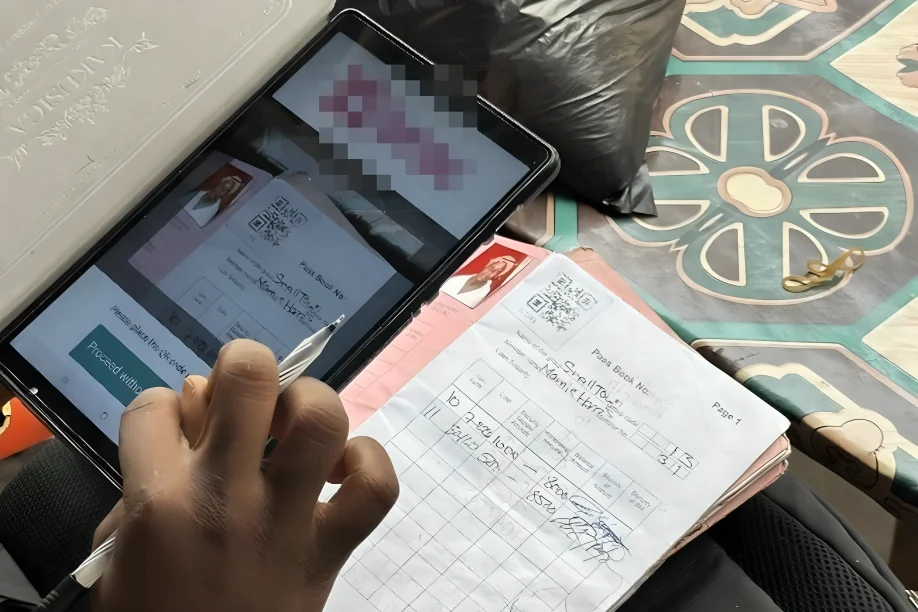
DFA digitized the process of instalment collection by traditional passbook, enabling field staff to instantly record client payment information and view transaction histories on handhelds.
First developed by a third-party and deployed in Rwanda in 2019, the client acquired the solution in 2021 and brought in brac IT to evolve the platform and lead its expansion. The goals driving this transformation were to improve operational efficiency, enable data-driven decision-making, generate reliable client-level data for social outcomes reporting, and support effective poverty targeting.
The Solution
CBS Integration
A key milestone was decoupling DFA from the client’s ERP called sbiCloud – also developed by brac IT – and integrating it with Temenos T24, a standardized Core Banking Solution (CBS). Rwanda became the first rollout country in 2022.
Unlike sbiCloud’s individual transaction handling, the CBS required bulk data transfers, placing new performance demands on both the field app and its web back-office, Mission Control. For a single field officer collecting repayments from 10 clients, DFA needed to generate 100 payloads for CBS authorization and back-office syncing. Its data payload structure was re-engineered with code optimizations to reduce payload creation and transfer times by 40–60%, enabling reliable service operations for over 120,000 clients in Rwanda.
DFA’s integration layer is API-driven and designed to be CBS-agnostic. Middleware can be implemented to ensure stability, buffering, and resilience to allow institutions to integrate with different banking ecosystems without being locked in.
Built for Field Realities
DFA is purpose-built for the environments where field staff predominantly use cost-effective Android smartphones. The application is deliberately optimized for Android to align with this deployment reality. Performance is tuned for low-to-mid-range devices and low-bandwidth conditions, enabling institutions to scale without significantly increasing hardware costs.
Village Organizations (VOs) are groups of women clients formed as part of the organization's holistic development approach. It’s designed to foster social capital, financial literacy, and collective action among its members. DFA offers functionalities for field officers to organize such group meetings and track attendance, enabling capture of client-level data to measure progress.
Offline capability is a core design principle, not a fallback. Business rules are enforced at the application level regardless of connectivity. Transaction data is securely stored in an encrypted local database and revalidated against the CBS upon synchronization. Every sync attempt, failure, and transaction log is captured and traceable. Additional safeguards include device authorization controls, root detection, data encryption, and optional location tracking – all configurable to the institution’s compliance framework.
Speed at Scale: The Liberia Challenge
In 2024, the client’s Liberian operations presented a new performance challenge post-integration. As the largest microfinance provider in the country with 42 branches and over 100,000 clients, its daily operations involved field officers visiting 700–800 client groups, each with 25–35 members on average. Transaction data for each group must be authorized sequentially on the CBS by a branch accountant before the next group’s data can be submitted.
At this volume, CBS response times had spiked to 15–20 seconds per transaction group, creating potential cumulative delays of over three hours per day. A targeted API fix reduced response times to under five seconds, restoring field efficiency and ensuring daily operations could close on time.
Governance, Security & Support
Visibility Across Every Level
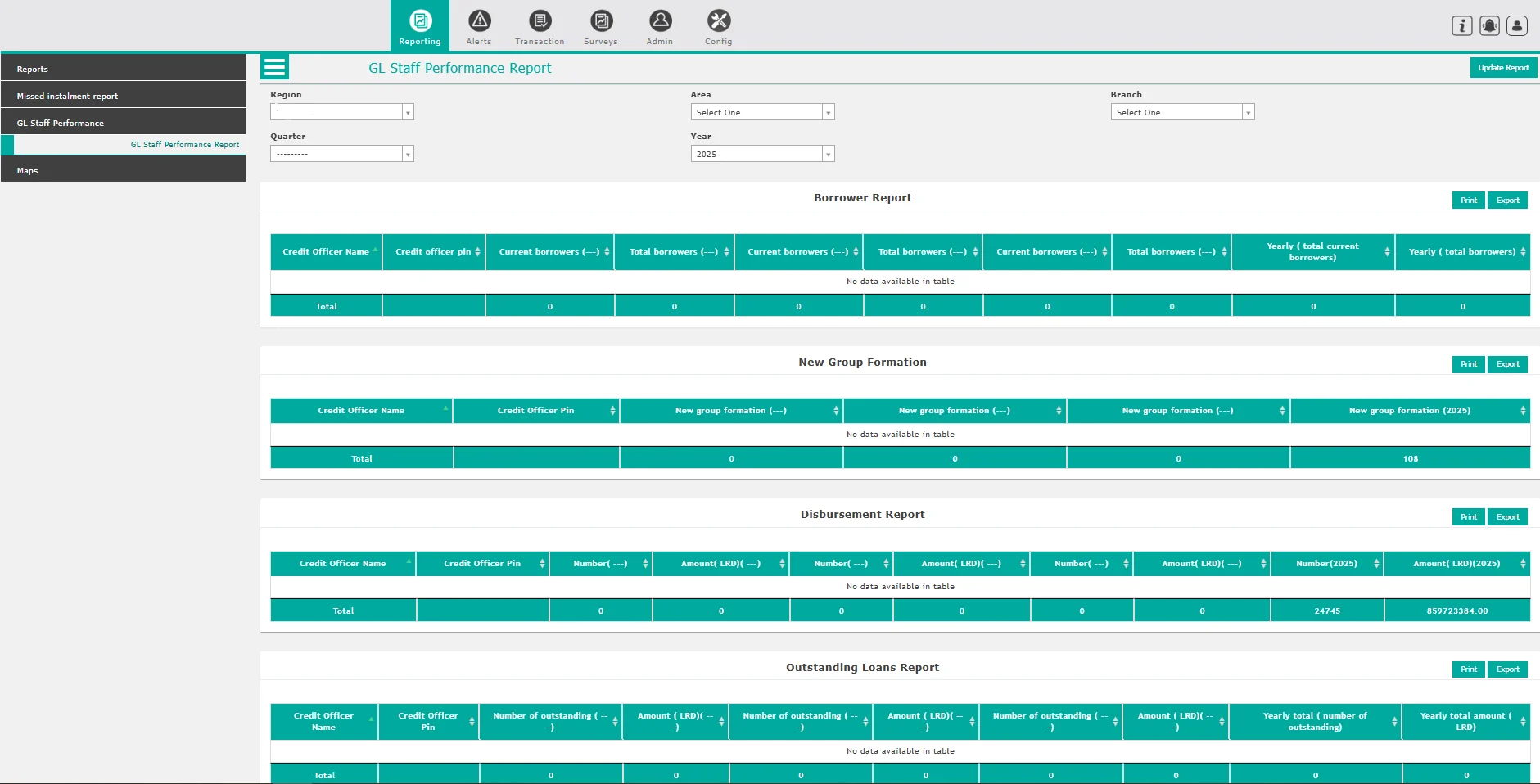
DFA’s web back-office is Mission Control. It provides role-based dashboards and reporting views tailored to every layer of management – from branch managers and regional supervisors to country-level leadership. Monitoring capabilities include field officer activity, daily collections, portfolio performance, pending or buffered transactions, and synchronization behavior. The design intent is not simply oversight, but operational insight and early exception detection.
DFA Mission Control caters to branch managers, regional supervisors, all the way to the CEO of each country. It hosts robust reporting and analytics to measure individual KPIs and branch/regional performance.
Audit Trails and Data Integrity
Every transaction carries a comprehensive audit trail – user login credentials, approval workflows, timestamps, modification logs, and synchronization history. On the infrastructure side, transactional data is stored in enterprise-grade environments using PostgreSQL for structured data, MongoDB for document-based data, and Redis for high-speed caching. Secure cloud object storage handles document and file management. All data is encrypted at rest and in transit, with role-based access control enforced throughout.
When operating offline, transactions are held in an encrypted local mobile database (such as RealmDB), protecting against device-level tampering until connectivity is restored and synchronization can occur. Data residency can be aligned with country-level regulatory standards where required.
Long-term Operational Partnership
brac IT’s support model is structured for scale. Deployments begin with a phased rollout across selected branches, ensuring controlled adoption and issue-stabilization before full expansion. Prior to go-live, Training of Trainers programs and detailed documentation equip internal teams for sustained operations.
I commend brac IT for the Digital Field Application’s effectiveness as we digitize our field operations. This partnership has been instrumental in creating efficiencies to deliver on our mission of financially empowering women living in poverty and strengthening their financial resilience.
C Wanjiru, Digital Transformation Lead
Post-deployment, a structured SLA framework governs support with defined severity levels, response timelines, and escalation pathways, calibrated to the client’s business hours and time zone. The dedicated DFA team at brac IT handles everything from feature enhancements and performance tuning to 24/7 uptime monitoring, remote configuration support, and data reconciliation.
The Tanzania Pilot
In 2025, we rolled out a structured pilot for client’s Tanzanian operations. The results delivered concrete evidence of the platform’s operational and business impact across six key dimensions.
High digital adoption: 72% of all transactions were processed through DFA across pilot branches, with 85% of member admissions, 74% of loan originations, and 59% of collections handled digitally.
Faster loan processing: Loan processing times reduced from a week to 1–2 days.
Earlier branch close-out: Branch operations were able to save 2 hours daily.
Lower operational costs: Printing costs fell by 55% with digitized workflows.
Improved data accuracy: CBS-integration improved reliability of transactions.
Strong SLA responsiveness: 100+ issues resolved within anywhere from 20 minutes to 4 hours.
Building on this success, the client has committed to a phased DFA expansion plan to be implemented fully in the country.
Impact & Future
Today, brac IT supports DFA operations in Rwanda, Ghana, Liberia, Sierra Leone, and Tanzania, with rollout plans underway for Kenya. Between 2022 and 2024, both Rwanda and Liberia’s microloan portfolios grew by over 95%, reflecting improved operational performance and scale.
The platform’s roadmap continues to expand. Two critical integrations are in development to further strengthen data accuracy and compliance.
Coupling with National ID databases for real-time client verification
Access to Credit Reference Bureaus for stronger risk assessments
Beyond the operational metrics, the larger impact is human. In 2023, the client commissioned an Impact Survey across five social outcome areas – quality of life, financial resilience, women’s economic empowerment, self-employment and livelihood opportunities, and household welfare. It was found that 80% of clients spend more on their children’s education. It’s reason enough to do what we do to support missions that positively impact millions of people.
About The Author
Jonathan Das
Communication Manager
Jonathan Das is a Communication Manager specializing in solutions storytelling and product marketing. He’s previously worked in brand and social media management, fund-raising, and audio-visual production roles with consumer brands, global non-profits, and startups. Jon holds a BA degree in communications from University of Liberal Arts Bangladesh. He enjoys making music, going on long walks, and reading about culture and technology.